Yellowstone is continuously monitored and conditions can change over time. View the Volcoholics volcano directory for the latest verified official position from the Yellowstone Volcano Observatory.
View latest Yellowstone status →Yellowstone
The world’s most famous caldera — a vast volcanic and hydrothermal system monitored continuously by the Yellowstone Volcano Observatory.
A volcano without a single cone
Yellowstone is a broad caldera and volcanic field, not a steep-sided mountain. Visitors can stand inside the volcano without seeing an obvious summit.
The present Yellowstone Caldera formed during a major eruption about 631,000 years ago. It sits above the youngest part of a long-lived volcanic track across the Snake River Plain, produced as the North American Plate moved over a deep source of heat.
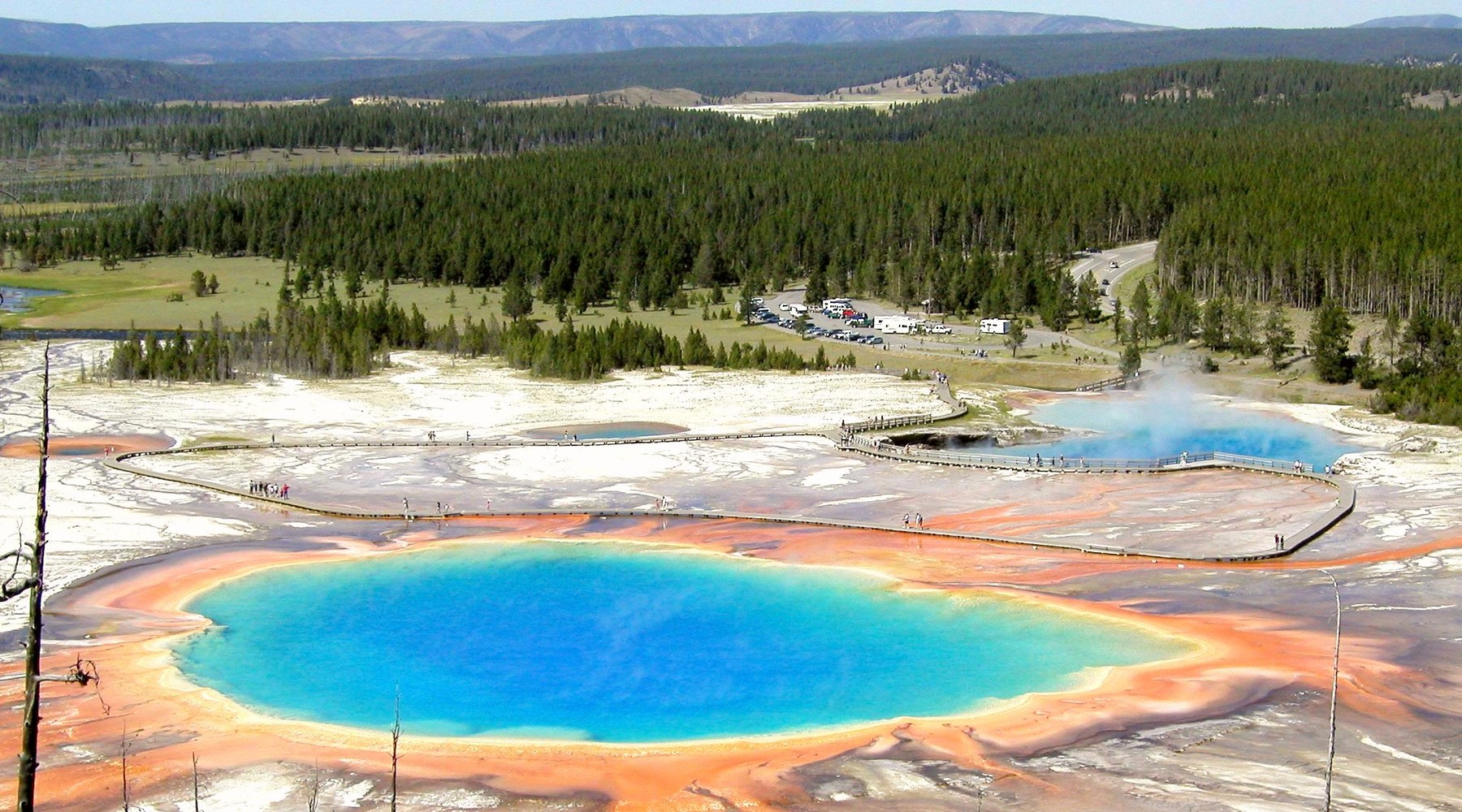
Volcanism did not end when the caldera formed. Large rhyolite lava flows continued intermittently, with the most recent lava eruption about 70,000 years ago. Today, heat from the magmatic system powers geysers, hot springs, fumaroles and mud pots across the national park.
“Supervolcano” is an informal label. It refers to Yellowstone’s ability to produce exceptionally large eruptions in its geological past, not to its current level of activity and not to a prediction of what the next eruption would look like.

Background activity, closely watched
The official status is Normal with Caldera size Green. That means monitored activity is consistent with Yellowstone’s usual background behaviour.
Earthquakes, changing geyser behaviour, seasonal deformation and occasional hydrothermal explosions can all occur during normal conditions. Scientists look for sustained changes across several datasets before concluding that the volcanic system is moving away from background.
Heat, rock, water and time
Yellowstone’s surface spectacle is created by interaction between hot rock, groundwater and a complex crustal magma system.
Geophysical imaging shows a large region of hot, partly molten rock beneath Yellowstone, but it is not a giant liquid tank. Most of the reservoir is solid crystal-rich material with melt distributed through it.
Rain and snowmelt seep underground, circulate through hot fractured rock and return to the surface as hot springs and geysers. Pressure can build in sealed hydrothermal systems, creating local explosions without a magmatic eruption.
Inside the Yellowstone system
The diagram is the important visual here: hot, crystal-rich crust feeds a vast hydrothermal system through fractures rather than one giant liquid magma chamber.

Why Yellowstone has swarms
Yellowstone is one of the most seismically active areas in the United States. Hundreds to thousands of earthquakes are located in a typical year, and many occur in swarms — clusters of events close together in time and space.
Swarms can result from fault movement and from changes in pressure as hydrothermal fluids move through fractured rock. Most are small and are not evidence that magma is rising toward the surface.

One of Earth’s best-watched volcanic systems
The Yellowstone Volcano Observatory is a consortium led by the USGS with university, state and National Park Service partners. It combines continuous instruments, satellite observations, fieldwork and long-term geological research.
Could Yellowstone erupt?
Yes — Yellowstone is an active volcanic system. But “active” does not mean an eruption is close, and a future event would not automatically be a super-eruption.
The most likely hazardous events on human timescales are hydrothermal explosions and earthquakes. If volcanism returned, geological history shows a range of possible outcomes, including lava flows and smaller explosive eruptions. A caldera-forming eruption is the rarest and most extreme scenario.
Two million years of Yellowstone volcanism
Huckleberry Ridge eruptions
Major eruptions formed a vast older caldera complex and deposited the Huckleberry Ridge Tuff.
Mesa Falls eruption
A smaller major caldera-forming event created the Henrys Fork Caldera southwest of Yellowstone.
Lava Creek eruption
The most recent caldera-forming eruption created the present Yellowstone Caldera.
Many lava eruptions
At least 28 recognised eruptions produced rhyolite flows and domes within the caldera after it formed.
Most recent lava eruption
The latest recognised volcanic eruption produced a rhyolite lava flow. Hydrothermal explosions continue in the modern era.
Yellowstone myths, separated from reality
The hazards that matter now
Hydrothermal explosions
Sudden steam-driven blasts are among Yellowstone’s most credible near-term geological hazards.
Earthquakes
Strong regional earthquakes can damage infrastructure and alter hydrothermal systems.
Ashfall
Any future explosive volcanic eruption could disrupt transport, aviation and communities downwind.
Hot water and steam
Thermal areas contain thin crust, boiling water and dangerous gases. Visitors must remain on marked routes.
Lava flows
Rhyolite lava would move slowly but could be extremely thick and reshape large areas.
Rare large eruptions
Large explosive events are part of the geological record, but current observations show no sign of one developing.
Famous does not mean imminent
Yellowstone deserves serious monitoring because it is active, complex and capable of multiple hazards. But its fame also attracts exaggerated claims. The responsible picture is straightforward: the volcano is currently at Normal, the monitoring network is extensive, and ordinary earthquakes or geyser changes are not evidence that a super-eruption is beginning.
Yellowstone questions answered
Is Yellowstone erupting now?
No. Yellowstone is not undergoing a magmatic eruption. Its alert level is Normal and aviation colour code is Green.
Is Yellowstone overdue for an eruption?
No. Eruptions do not follow a timetable, and the intervals between major Yellowstone eruptions are not regular enough to define an “overdue” date.
How many earthquakes happen at Yellowstone?
Hundreds to thousands may be located in a year. Most are small, and earthquake swarms are a common part of background activity.
What is a supervolcano?
It is an informal term commonly applied to volcanic systems that have produced extremely large eruptions. It is not an official alert category.
Is there a giant liquid magma chamber?
No. Imaging indicates a large region of hot, mostly solid and crystal-rich rock containing distributed melt.
What was Yellowstone’s last eruption?
The most recent recognised lava eruption occurred about 70,000 years ago. Hydrothermal explosions have occurred much more recently.
Could scientists detect warning signs?
A major magmatic intrusion would be expected to produce strong, sustained changes across earthquakes, deformation, gas and heat flow. No monitoring system can promise an exact eruption date.
Who provides official Yellowstone updates?
The USGS Yellowstone Volcano Observatory publishes official status updates in partnership with collaborating agencies and institutions.
Built from the scientists watching Yellowstone
This profile prioritises the USGS Yellowstone Volcano Observatory and National Park Service. Geological context and status language are based on official YVO resources and public-domain USGS material.